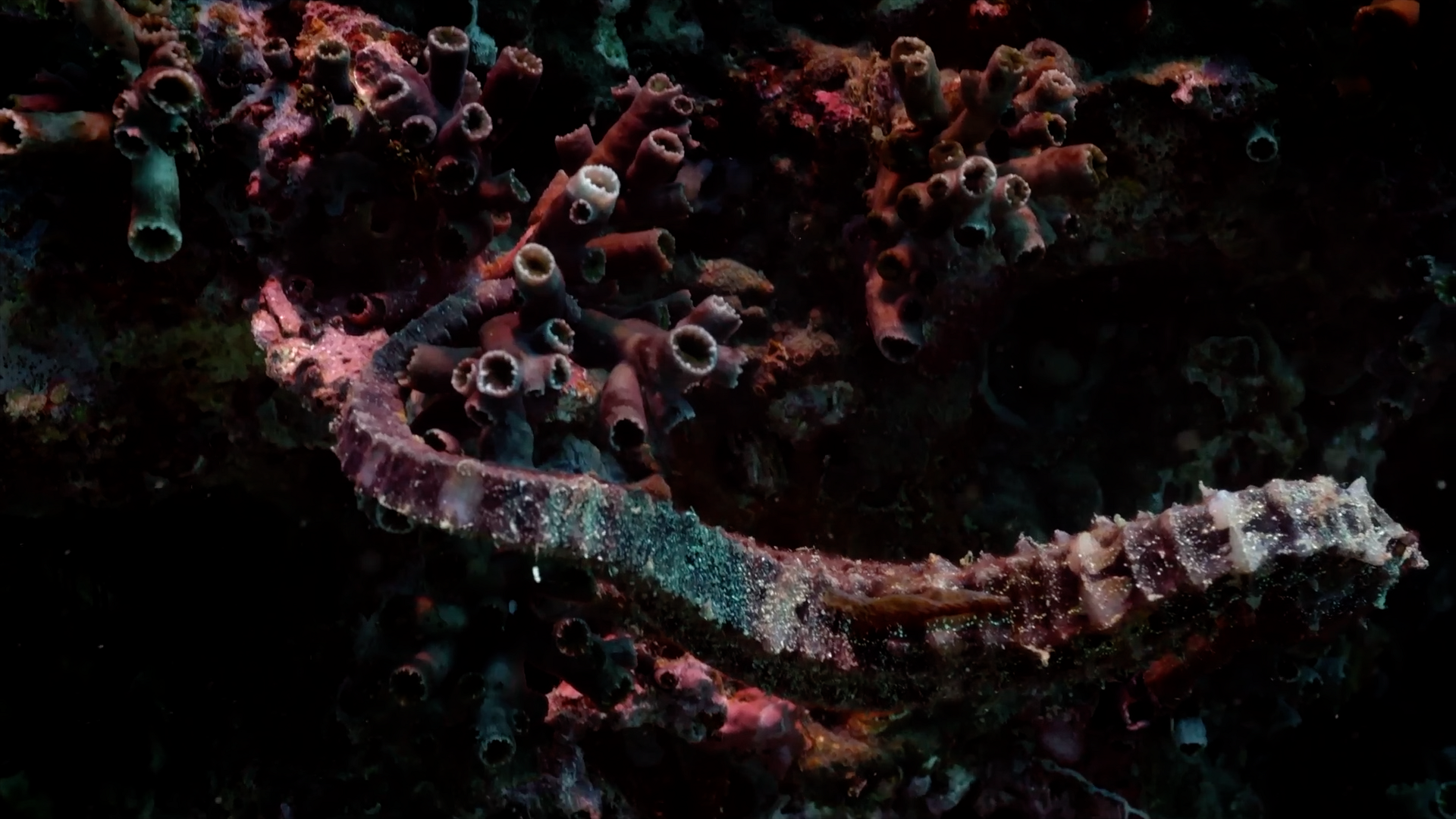
This photo montage of seahorses has been created from screenshots of film footage taken in the Dimaniyat Islands, Oman. Together they show various characteristics of this mysterious marine creature - fascinating body armour detail up close in macro as well as cryptic coloration seen in the wider frames where, amongst the sea fans, this Great Seahorse blends perfectly into its reef environment and can remain hidden in plain sight for hours at a time.
Seahorses are elusive, so it was no surprise that during this five-week shoot in the Gulf of Oman I only found myself in a position to film them twice. I’d previously captured these graceful aquatic animals on film in Barbados and Singapore but regardless of location it is always an exciting challenge to see them in their natural habitat. The scientific classification of a seahorse is Hippocampus, which comes from a combination of the Ancient Greek words ‘hippos’ meaning horse and ‘kampos’ meaning sea monster. For me, despite their size, this tiny fish carries mesmerising power and mythical appeal. It’s always considered a special dive when seahorses are spotted, and every encounter is a pleasure and a privilege.
They swim upright, propelling themselves using the dorsal fin which moves at a rate of 70 beats/second, the same frequency as a hummingbird’s wing. Manoeuvring by using just pectoral fins located either side of their head, seahorses make surprisingly poor swimmers, with the slowest species travelling at just five feet/hour. Because of this, you mostly find them anchored to their surroundings by their prehensile tail, swaying in the current whilst keeping a close lookout for predators and food, using eyes which can move independently facilitating almost 360 degree vision. Seahorses are generally considered tricky subjects to film, as they have a habit of being very camera shy, constantly turning their backs and swimming away as soon as you get close. However, for this sequence I was blessed with a relaxed individual who was very comfortable and at peace with my camera and quadpod set up - he didn’t seem to mind my being in his world at all and carried on with his natural behaviour allowing me to get a strong sequence.
Most seahorse species form monogamous bonds which last the annual breeding season and, during this time, elaborate courtship behaviour takes place in which the female deposits her eggs into the male’s brood pouch. Unusually, up to one month later it is the male that gives birth to hundreds of miniature seahorses - a phenomenon first captured on film by French cinematographer Jean Painlevé in his piece ‘The Seahorse’ 1934.
Globally, almost a third of the world’s 44 seahorse species are classified as either endangered (EN) or vulnerable (VU) on the IUCN Red List of Threatened Species. Closer to home, the Short-snouted and Long-snouted Seahorse species have been protected by English law since 2008 and can be found in UK seagrass meadows which grow in shallow, sheltered areas along our coastline. Like coral reefs, these underwater habitats are full of life and form an important nursery for juvenile fish including seahorses. However, this fragile ecosystem is under threat from trawling, dredging, pollution and mooring activity.