
Your Custom Text Here

'The Earthshot Prize' BBC
The Earthshot Prize has been designed to find and grow the solutions that will repair our planet this decade. Warming temperatures, pollution and harmful fishing practices are having a devastating impact on our oceans, but our three ‘Revive our Oceans’ finalists for The Earthshot Prize 2022 have developed solutions so that our oceans can thrive.
Human activities and the climate crisis are decimating underwater seaweed forests. The team at SeaForester utilize an ingenious solution: “green gravel”. Unlike trees, seaweed needs no soil or fertiliser. Seaweed spores are seeded onto small stones and scattered into the ocean. The stones latch on to the underlying reef, the seaweed grows and multiplies, spreading across the ocean floor.
To read more about the SeaForester project please click here

'Whale with Steve Backshall' Sky
Following on from the success of Sky Nature’s Shark with Steve Backshall, Steve sets out to reveal that whales are ‘mightier than myth’. In this brand-new series, Steve takes us deeper and closer to the most iconic, mysterious and threatened whales and their dolphin cousins.
As a naturalist, conservationist and Sky Ocean Hero Ambassador, Steve will free dive alongside whales in the world’s greatest oceans. We’ll meet mighty sperm whales, caring humpback whales, intelligent killer whales and ingenious bottlenosed dolphins, exploring their complex social relationships, revealing their surprising hunting techniques, and discovering that just like us, many whales have close family units. Teaming up with world-leading scientists and conservationists, Steve will uncover the secret lives of whales and dolphins, and confront the uncomfortable and urgent truths of overfishing and pollution. Joining whale advocates across the globe, he will discover why whales are essential for the health of our oceans, what we can do to ensure their survival, and reveal the most remarkable conservation story of all.

'Patrick and the Whale' First Encounter
While swimming near the Caribbean island of Dominica in 2019, Patrick Dykstra has a momentous meeting with a sperm whale - the following clip was filmed by Mark as part of the ‘Chasing Ocean Giants’ series however, this chance encounter became the inspiration and foundation of a feature documentary called 'Patrick and the Whale'.
Following this encounter Patrick was encouraged to gain further insights into the mysteries of whales; how they interact, sing to each other, form bonds, and express emotion. His quest to connect with and understand the hidden nature of the sperm whale is explored in ‘Patrick and the Whale’ a PBS film produced by Terra Mater Studios which shines a light on their intelligence and complexity, as well as highlighting their current and past relationship with humankind.
Sadly Mark was unavailable for the follow up trip to Dominica but has an incredible memory capturing the Patrick’s first meeting with ‘Dolores’.

'Deadly Mission Shark' CBBC
Deadly Mission Shark is the toughest challenge yet, to protect the future of sharks who are facing extinction. Steve Backshall and a team of kids from the UK and Bahamas step in to inspire and change the world. But will the kids complete their mission and learn to dive with sharks?
Watch here

'Life on Our Planet' Netflix
Life's extraordinary journey to conquer, adapt and survive on Earth across billions of years comes alive in this groundbreaking nature documentary. Narrated by Morgan Freeman and Executive Produced by Steven Spielberg and the team behind "Our Planet."
Chapter 1: The Rules of Life: Evolution. Competition. Mass extinction. Three fundamental rules have driven the rise and fall of life on Earth for over four billion years.
Chapter 2: The First Frontier: For billions of years, land on Earth was uninhabitable. But in the seas, predation allowed species to thrive before — and after — two mass extinctions.
Chapter 3: Invaders of the Land: Sprawling moss, towering trees, flying insects, limbed amphibians: Early species vied for domination as the land went from hostile to hospitable.
Chapter 4: In Cold Blood: After Earth's third mass extinction, mammals' surviving ancestors ruled the supercontinent Pangea. But lizards soon ushered in the age of reptiles.
Chapter 5: In the Shadow of Giants: The formation of continents with varied environments allowed for an explosion of biodiversity — and turbo-charged the evolution of mighty dinosaurs.
Chapter 6: Out of the Ashes: The dinosaurs met their end with a cataclysmic asteroid impact. Rising from the ashes, birds reinvented themselves into a dynasty 10,000 species strong.
Chapter 7: Inheriting the Earth: Emerging from the dinosaurs' shadows, mammals went from underdogs to global power, with game-changing adaptations that would conquer land, air and sea.
Chapter 8: Age of Ice and Fire: As the Ice Age thawed, humans rose above the rest. But the possibility of a sixth mass extinction now looms: Has our ingenuity caused our downfall?

'Evolution Earth' PBS, Sky Nature & NOW
Traveling to the far corners of the world, we discover the extraordinary ways animals are adapting to our rapidly changing planet. We witness nature’s remarkable resilience, as our perception of evolution and its potential is forever transformed. A series revealing how the animals around us are adapting to our changing planet and evolving before our eyes. Narrated by Shane Campbell-Staton
On the Galápagos Islands, Greg Lewbart and his team are trying to catch a marine iguana. Their goal is to study the iguana’s unusual adaptation. They have evolved the ability to shrink and regrow their vertebrae in response to changes in food availability. These conditions arises when the Pacific Ocean that is home to the algae they feed on warms, a result of the weather system known as El Niño.
S1: E1: Earth
S1: E2: Islands
S1: E3: Heat
S1: E4: Ice
S1: E5: Grasslands
Now available in the UK on Sky Nature and NOW TV.

'Super/Natural' Disney+
Using the latest scientific innovations and filmmaking technology, the powers and super-senses of the world's animals will be revealed, inviting viewers to experience the natural world as a specific species does. Narrated by Benedict Cumberbatch.

'Expedition with Steve Backshall' (S.2) PBS
Host Steve Backshall travels the world seeking out adventurous expeditions such river rafting in the Himalayas, trekking through the jungles of South America and climbing mountains in the Middle East.

'Epic Adventures with Bertie Gregory' Disney+
“I had the pleasure of joining Bertie and the Epic Adventures (series one) team in October 2020 to film around the island of Cocos, 550km off the coast of Costa Rica. It was my first shoot back after six months of lost work due to the Covid lockdowns that year and this was the first shoot in Cocos in a run of three I did there within 12 months. We stayed on the M/V Sharkwater, which is operated by Fins Attached NGO. We had some great encounters with Galapagos, scalloped hammerhead and tiger sharks, as well as huge schools of jacks and a general abundance of aquatic life as a result of Cocos being a protected area, although the threat of illegal fishing seems like an ongoing nearby threat.”

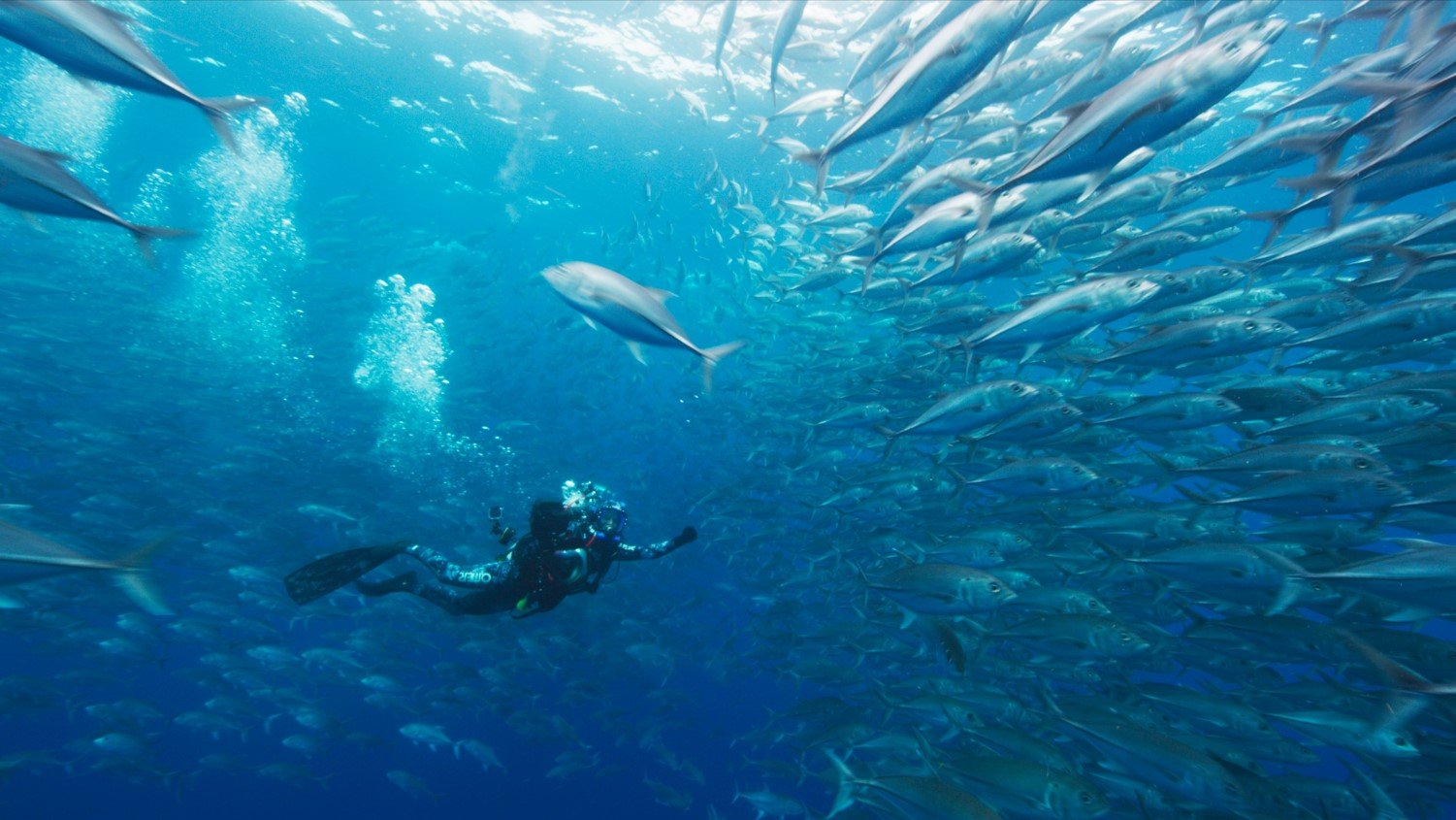


Part wildlife and part adventure show, follow the escapades of young National Geographic Explorer Bertie Gregory as he travels the world capturing extraordinary footage of wild animals. Using a combination of technical wizardry, secret fieldcraft and extreme perseverance, he and his team try to overcome the challenges and dangers and get as close as possible to wildlife on its own terms.

'Shark with Steve Backshall' Sky
Shark with Steve Backshall is a revelatory series that celebrates the wonder of sharks and dispels the myth of sharks as just cold blooded killers.
Steve Backshall, a naturalist and shark expert, gets us closer to sharks, to encounter a diverse and incredible family of over 400 different types. This global journey will take us to the remotest parts of our planet, from the sun-drenched tropics to the mysterious depths of our oceans. Teaming up with world-leading scientists, Steve will make stunning discoveries, revealing glow in the dark sharks, sharks that walk on land and ancient sharks over 400 years old. Now more than ever this incredible family needs our help. Every hour we lose over 11,000 sharks to overfishing, shark finning and habitat destruction. Steve will confront the uncomfortable truths and join shark advocates across the globe to help turn the tide for sharks. Coming eye to eye with this feared yet misunderstood predator, Steve will reveal sharks in a brand new light.
In the Eastern Pacific lies Cocos - the island of the sharks. While filming for ‘Shark with Steve Backshall’ Steve, Mark and the team battled weather and stormy seas to document the shivers of hammerheads that gather here…

'Chasing Ocean Giants' Discovery+
Ocean explorer, adventurer and filmmaker Patrick Dykstra sets out on a mission in search of the most elusive ocean giants on the planet. He uses innovative technology and new science to uncover extraordinary secrets of the ocean.
S01 E01: Whale vs. Squid: Patrick travels to the volcanic island of Dominica in the Caribbean. Whilst there he captures an epic hunt between a sperm whale and a diamondback squid.*
S01 E02: Panama’s Boiling Sea: Patrick heads to Panama, where his desire to witness the spotted dolphin and yellowfin tuna working together lands him in dangerous territory.
S01 E03: Humpbacks After Dark: The remote island of Gorgona in Colombia is Patrick’s next stop. During a two-night dive, he captures how humpback whales communicate through song.
S01 E04: From Russia With Bowheads: Patrick travels to Russia to find a bowhead whale. After a near death experience with this species years ago, he is determined to examine their behaviour.
S01 E05: Whale Sharks Of Qatar: Patrick travels to Qatar to find a newly discovered cluster of whale sharks. High winds and extreme sea temperatures prove to be big challenges along the way.
S01 E06: Manta Ray Tornado: Patrick heads to the Maldives to dive alongside the giant manta ray. He witnesses the fabled "Manta Ray Tornado" and examines the behaviour of this incredible species.
S01 E07: Shark City Of Palau: In Palau, Patrick tackles his most difficult dive ever. He battles typhoon-like weather in order to witness the mass spawning event of red snappers.
S01 E08: Killer Whales Of Norway: Patrick travels to Norway with hopes of diving alongside killer whales. Whilst there he examines how these creatures adapt their hunting behaviour.*
*Mark filmed underwater and topside (sync and aerial) for E01 sperm whales in Dominica and E08 orca in Norway. He also filmed footage in Norway and Sri Lanka for the pilot episode to help get the series commissioned as well as shooting the first episode which helped establish the visual style and tone for the series.
'Animals with Cameras' BBC
In this three-part series, wildlife cameraman and presenter Gordon Buchanan collaborates with scientists in the field to attach cameras onto animals in the wild. On their journey, which takes them to all corners of the globe, they uncover unexpected findings about the lives of some of the planet's most captivating species. Mark filmed off the Princess Alice sea bank in the Azores during August 2017 for the Devil Ray sequence (featured in episode 3).
The team set out to discover why vast numbers of Devil Ray gather every summer near the Azores archipelago in the mid-Atlantic. The team successfully deployed specially designed cameras which towed behind the rays, these in turn witnessed wildlife spectacles seen for the first time including 'sun-bathing' ray at the surface reheating after a cold dive and unborn ray pups kicking inside their giant, four-meter-wide mothers; a sign that this congregation might be a breeding ground for these majestic ocean giants. Devil Rays are under threat from fishing, boat traffic, habitat decline and pollution and are currently listed as Endangered (EN) on the IUCN Red List. Although not usually targeted by fisheries, Devil Rays often become victims as bycatch. The good news is that Project AWARE have already made a positive impact to help protect Devil Rays.
“Devil Rays are fascinating creatures – they are some of the fastest and deepest divers in the ocean, and swim with such elegance. When they are not feeding, their cephalic fins are curled and point forward and down, giving the appearance of devil horns; hence their name.”


Other wildlife events captured within this series include penguins catching their prey 200 miles off the coast of Argentina and fur seals avoiding attacks from great white shark off Australia. Further details and clips are available here.
SCRUBD Master of the Month

As champions of men, SCRUBD are passionate about helping men to be masters in every area of their life. Every month we interview a true master, who is making a difference in the world around him.
Usually found behind the camera, this month the spotlight is on wildlife and underwater cameraman Mark Sharman who has worked on some of the most exciting wildlife documentaries of our time including the award-winning Jago a Life Underwater and Blue Planet II which has recently aired on BBC One.
How did you get involved in underwater filming and how did it feel filming underwater for the first time?
“I have been fascinated by scuba diving and the underwater world since I was a child. Scuba diving was a natural step for me as I was a competitive swimmer as a teenager and was always in and around the water growing up. I studied Television Production at university and after this I got my first jobs in the industry, as well as my first decent time diving on a conservation project. I put my two interests of camerawork and scuba diving together for a job in the Red Sea filming tourists and selling them a DVD of their week of diving. I felt a great sense of accomplishment getting to a place where I could put my two main interests together, and proud that I was on the way to achieving what I had set out to do.”
What are the most important skills needed to master underwater filming?
“Early on before I embarked on my career I was given the advice that you can’t create good underwater camerawork unless you have mastered neutral buoyancy, which is the most important part of being a scuba diver. The only way to do this is to get hundreds of dives under your belt in various conditions. The underwater filming process involves your scuba diving reflexes becoming automatic, so you can concentrate 100% on what you’re filming, without thinking about your position in the water. That, and manoeuvring around extremely delicate corals on the reef is an important part of the job, and the training and practice is endless.”
Natural History programmes have evolved with advances in technology – what new skills have you had to develop to maintain your craft?
“I’ve continually developed my craft and pushed new boundaries to keep up my skills as an all round cameraman, both on the land and underwater. Becoming a rebreather diver was a important step, as it is allows you to spend a lot more time underwater and get closer to certain marine life. That was like learning diving from scratch, and requires neutral buoyancy to be re-learned in a new way.
This year I’ve developed my drone flying skills to be able to fly and film aerial shots, and these skills need constant refinement and practice to be able to perform and deliver on demand right when the action is happening. There are not often second chances, so you have to be ready when the action starts, which takes a lot of dedication and time to achieve.”
‘Jago a Life Underwater’ is an award-winning film about the life story of an old Bajau man. What was it like to work with these underwater masters and film them in their element?
“Jago was an amazing production to work on; a low-budget, self-funded passion project by directors James Reed and James Morgan. It was the first time I’d met any Bajau people, or sea gypsies, and being able to tell a story from their point of view was special. They were incredible in the water, able to hold their breath for several minutes as they hunted with a spear-gun. Being able to work with people so adept in their environment was quite something, and really satisfying to be a part of such a small project which has received some of the biggest awards in the industry.”
Capturing the natural world on camera can be time consuming. How long would you spend filming in order to get all the footage required for a sequence?
“Shoots are generally between two and five weeks, three weeks is about average for a sequence you might see in a programme like Blue Planet II. Sometimes you get nothing for the first two weeks and everything happens on the last day….there have been a few of those. Developing patience and remaining upbeat and positive when the chips are down are key skills to master.”
What is your most memorable moment and have you had any scary encounters filming in the wild?
“Filming large marine life has been the most thrilling so far, it really reminds you of your size and place. I’ve filmed beside Whale Sharks, Sperm Whales, Humpback Whales and Orcas which were all incredibly memorable experiences. I’ve also had a brown Bear mother walk her two young cubs right past where I was sitting. In my experience all of these wild animals are generally quite shy and move away from you, so when the odd one allows you to stay close and film for a few minutes, they are really special moments. I don’t see the natural world as a scary place; wildlife is often misunderstood and sensationalised in the media, so I have a healthy respect for something which could do me harm. Ultimately you are in their domain so you have to move and act accordingly, and take advice from experts, and everyone is happy. The only time I’ve genuinely been threatened in the wild, is an encounter with poachers, whilst on patrol with eco guards in Gabon, filming the capture of a poacher and being shot at by the guys who ran away. I filmed the whole thing and it wasn’t until after the adrenaline wore off did I think of the danger we were in.”
What advice would you give to aspiring documentary makers?
“It’s going to be a long haul, so building resilience to set backs is key. There will always be double the amount of knock backs as there will be big breaks, so you’ve just got to keep going and keep finding different angles in. It’s a very competitive area to get into, so a deep and unshakable passion is needed. Getting any experience in the industry is a good move, taking every opportunity to learn and develop the craft with hands-on experience. Meet as many people as possible in the industry and keep in touch with them. Most of my work comes from recommendation, by reputation and from people I already know, so the bigger the network, the more chance there is of work coming in. People like working with nice people, so being easy and fun to work with is also something to consider.”
Quick Fire
How do you master your day?
“Going to the pool or gym in the morning, with a walk back home along the coast sets things up well. If there’s a lot of admin to do, getting fresh air, either with a walk, run or a drone flight by the sea is good for clearing the head. Getting through my list of things to do keeps everything ticking over and on track.”
If you could have dinner with three male masters, who would they be and why?
“David Attenborough, Ernest Hemingway, Alfred Hitchcock. Three men’s work I’ve greatly enjoyed and admired. All story-tellers by trade, it would be a masterclass.”
The best piece of advice you have ever received?
“Stay focussed and keep going.”