
Your Custom Text Here

'The Earthshot Prize' BBC
The Earthshot Prize has been designed to find and grow the solutions that will repair our planet this decade. Warming temperatures, pollution and harmful fishing practices are having a devastating impact on our oceans, but our three ‘Revive our Oceans’ finalists for The Earthshot Prize 2022 have developed solutions so that our oceans can thrive.
Human activities and the climate crisis are decimating underwater seaweed forests. The team at SeaForester utilize an ingenious solution: “green gravel”. Unlike trees, seaweed needs no soil or fertiliser. Seaweed spores are seeded onto small stones and scattered into the ocean. The stones latch on to the underlying reef, the seaweed grows and multiplies, spreading across the ocean floor.
To read more about the SeaForester project please click here

'Whale with Steve Backshall' Sky
Following on from the success of Sky Nature’s Shark with Steve Backshall, Steve sets out to reveal that whales are ‘mightier than myth’. In this brand-new series, Steve takes us deeper and closer to the most iconic, mysterious and threatened whales and their dolphin cousins.
As a naturalist, conservationist and Sky Ocean Hero Ambassador, Steve will free dive alongside whales in the world’s greatest oceans. We’ll meet mighty sperm whales, caring humpback whales, intelligent killer whales and ingenious bottlenosed dolphins, exploring their complex social relationships, revealing their surprising hunting techniques, and discovering that just like us, many whales have close family units. Teaming up with world-leading scientists and conservationists, Steve will uncover the secret lives of whales and dolphins, and confront the uncomfortable and urgent truths of overfishing and pollution. Joining whale advocates across the globe, he will discover why whales are essential for the health of our oceans, what we can do to ensure their survival, and reveal the most remarkable conservation story of all.

'Patrick and the Whale' First Encounter
While swimming near the Caribbean island of Dominica in 2019, Patrick Dykstra has a momentous meeting with a sperm whale - the following clip was filmed by Mark as part of the ‘Chasing Ocean Giants’ series however, this chance encounter became the inspiration and foundation of a feature documentary called 'Patrick and the Whale'.
Following this encounter Patrick was encouraged to gain further insights into the mysteries of whales; how they interact, sing to each other, form bonds, and express emotion. His quest to connect with and understand the hidden nature of the sperm whale is explored in ‘Patrick and the Whale’ a PBS film produced by Terra Mater Studios which shines a light on their intelligence and complexity, as well as highlighting their current and past relationship with humankind.
Sadly Mark was unavailable for the follow up trip to Dominica but has an incredible memory capturing the Patrick’s first meeting with ‘Dolores’.

'Deadly Mission Shark' CBBC
Deadly Mission Shark is the toughest challenge yet, to protect the future of sharks who are facing extinction. Steve Backshall and a team of kids from the UK and Bahamas step in to inspire and change the world. But will the kids complete their mission and learn to dive with sharks?
Watch here

'Life on Our Planet' Netflix
Life's extraordinary journey to conquer, adapt and survive on Earth across billions of years comes alive in this groundbreaking nature documentary. Narrated by Morgan Freeman and Executive Produced by Steven Spielberg and the team behind "Our Planet."
Chapter 1: The Rules of Life: Evolution. Competition. Mass extinction. Three fundamental rules have driven the rise and fall of life on Earth for over four billion years.
Chapter 2: The First Frontier: For billions of years, land on Earth was uninhabitable. But in the seas, predation allowed species to thrive before — and after — two mass extinctions.
Chapter 3: Invaders of the Land: Sprawling moss, towering trees, flying insects, limbed amphibians: Early species vied for domination as the land went from hostile to hospitable.
Chapter 4: In Cold Blood: After Earth's third mass extinction, mammals' surviving ancestors ruled the supercontinent Pangea. But lizards soon ushered in the age of reptiles.
Chapter 5: In the Shadow of Giants: The formation of continents with varied environments allowed for an explosion of biodiversity — and turbo-charged the evolution of mighty dinosaurs.
Chapter 6: Out of the Ashes: The dinosaurs met their end with a cataclysmic asteroid impact. Rising from the ashes, birds reinvented themselves into a dynasty 10,000 species strong.
Chapter 7: Inheriting the Earth: Emerging from the dinosaurs' shadows, mammals went from underdogs to global power, with game-changing adaptations that would conquer land, air and sea.
Chapter 8: Age of Ice and Fire: As the Ice Age thawed, humans rose above the rest. But the possibility of a sixth mass extinction now looms: Has our ingenuity caused our downfall?

'Evolution Earth' PBS, Sky Nature & NOW
Traveling to the far corners of the world, we discover the extraordinary ways animals are adapting to our rapidly changing planet. We witness nature’s remarkable resilience, as our perception of evolution and its potential is forever transformed. A series revealing how the animals around us are adapting to our changing planet and evolving before our eyes. Narrated by Shane Campbell-Staton
On the Galápagos Islands, Greg Lewbart and his team are trying to catch a marine iguana. Their goal is to study the iguana’s unusual adaptation. They have evolved the ability to shrink and regrow their vertebrae in response to changes in food availability. These conditions arises when the Pacific Ocean that is home to the algae they feed on warms, a result of the weather system known as El Niño.
S1: E1: Earth
S1: E2: Islands
S1: E3: Heat
S1: E4: Ice
S1: E5: Grasslands
Now available in the UK on Sky Nature and NOW TV.

'Super/Natural' Disney+
Using the latest scientific innovations and filmmaking technology, the powers and super-senses of the world's animals will be revealed, inviting viewers to experience the natural world as a specific species does. Narrated by Benedict Cumberbatch.

'Expedition with Steve Backshall' (S.2) PBS
Host Steve Backshall travels the world seeking out adventurous expeditions such river rafting in the Himalayas, trekking through the jungles of South America and climbing mountains in the Middle East.

'Epic Adventures with Bertie Gregory' Disney+
“I had the pleasure of joining Bertie and the Epic Adventures (series one) team in October 2020 to film around the island of Cocos, 550km off the coast of Costa Rica. It was my first shoot back after six months of lost work due to the Covid lockdowns that year and this was the first shoot in Cocos in a run of three I did there within 12 months. We stayed on the M/V Sharkwater, which is operated by Fins Attached NGO. We had some great encounters with Galapagos, scalloped hammerhead and tiger sharks, as well as huge schools of jacks and a general abundance of aquatic life as a result of Cocos being a protected area, although the threat of illegal fishing seems like an ongoing nearby threat.”

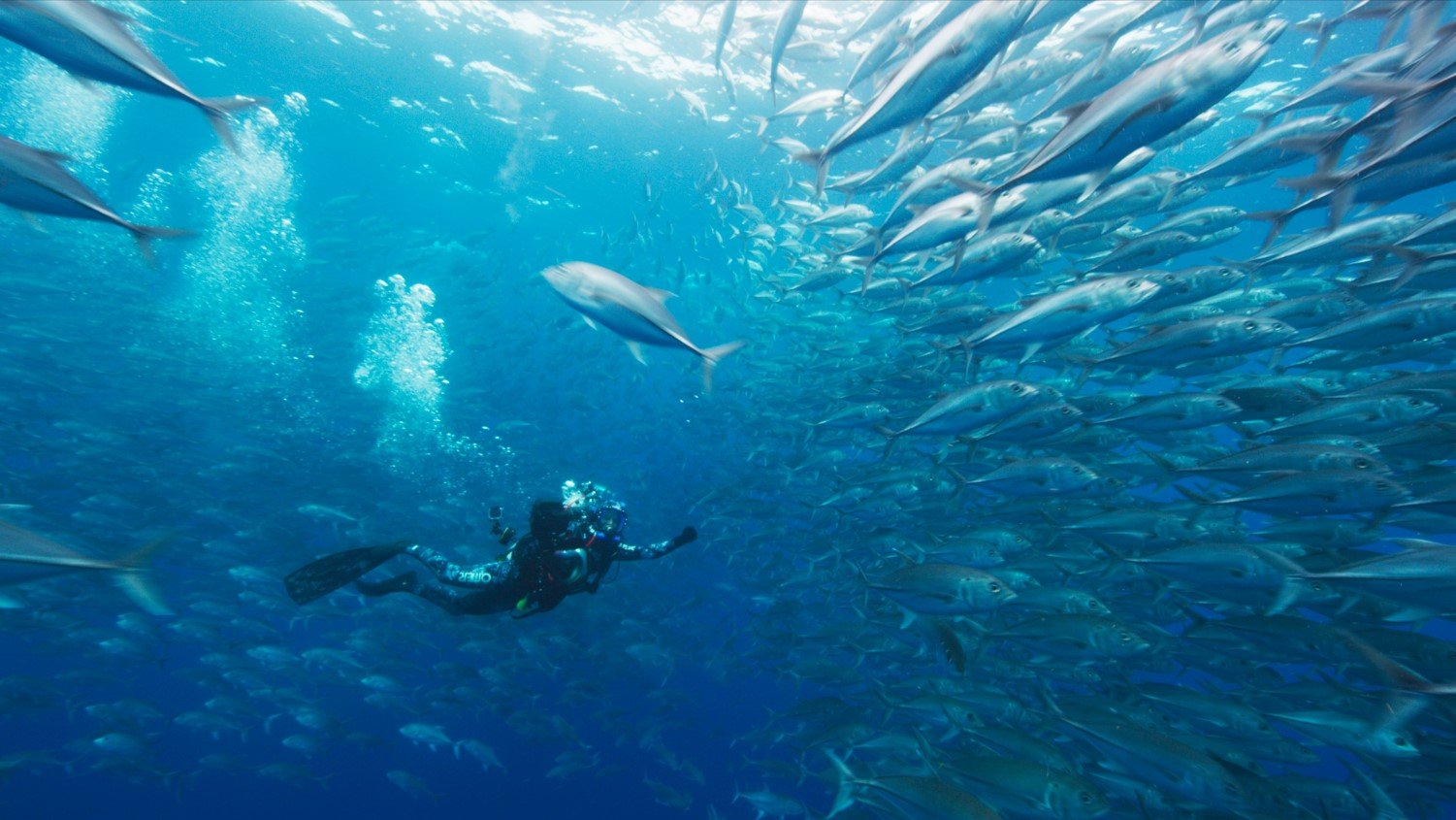


Part wildlife and part adventure show, follow the escapades of young National Geographic Explorer Bertie Gregory as he travels the world capturing extraordinary footage of wild animals. Using a combination of technical wizardry, secret fieldcraft and extreme perseverance, he and his team try to overcome the challenges and dangers and get as close as possible to wildlife on its own terms.

#HelpOurKelp Campaign Success
“The loss of the Sussex kelp forests over the past 40 years is a tragedy. We’ve lost critical habitat that is key for nursery grounds, for water quality and for storing carbon. This marine rewilding project, if approved, will ensure the Sussex seas remain healthy for generations to come, and could have far-reaching impact for other parts of the UK coast.”

During the summer whilst on paternity leave Mark played a small part in filming both healthy and bare kelp patches in the coastal areas off his hometown of Selsey for inclusion within this film produced by Big Wave Productions, Chichester.
Kelp once stretched along 40 km of the West Sussex coastline from Selsey to Shoreham, forming an underwater forest that extended at least 4 km seaward. It provided a vital habitat, nursery and feeding ground for seahorses, cuttlefish, lobster, sea bream and bass. It locked up huge quantities of carbon, helping us to fight climate change while improving water quality and reducing coastal erosion by absorbing the power of ocean waves.
But within living memory, kelp in Sussex waters has diminished to almost nothing. Storm damage, changing fishing practices and the dumping of sediment spoils by dredging boats have taken their toll on this sensitive habitat. The wildlife associated with it has all but disappeared, and the vital ecosystem services it provided have been lost.
“ If we want healthy seas that are sustainable for wildlife and fishing for generations to come, we urgently need to give our kelp forests a chance to regenerate. The introduction of a new bylaw to restrict trawling along the Sussex coast is critical.”

Historically, Kelp was abundant along the West Sussex coastline (left image: 1980) but this important habitat has diminished over time (right image: 2019)

Proposed trawler exclusion zone

Big Wave Team L-R: Researcher Eoin Dillon, Exec Producer Sarah Cunliffe, Sir David Attenborough, Mark Sharman and James Blake
Latest news: The campaign has now achieved its first major milestone as the introduction of a critical new byelaw (which will see trawling excluded from a vast 304 km2 of Sussex coastline year-round) agreed by the Sussex Inshore Fisheries and Conservation Authority on 23 January 2020. The decision was made following an extensive consultation period, which saw overwhelming support demonstrated by almost 2,500 people in response to the ‘Help Our Kelp’ campaign.
Sussex IFCA’s decision brings the first ever marine kelp rewilding initiative one step closer, and aims to give the kelp the breathing space it needs to recover. Over time, repeated passes by trawling vessels have torn kelp from the sea floor and prevented natural regeneration, so the alleviation of this major pressure is the critical first step towards recovery…
Help Our Kelp’ has been formed in partnership with the following organisations:
Sussex Inshore Fisheries and Conservation Authority
Big Wave Productions
Blue Marine Foundation
Sussex Wildlife Trust
Marine Conservation Society
Thanks also go to Steve at Mulberry Divers who are based in Selsey, West Sussex.

Ice and Cavern Diving at Plura, Norway
Plura is one of the biggest underground rivers in Norway and the unique diving opportunities here offer incredibly good visibility (up to 75m during April/May), beautiful underwater, marble caves and thick ice cover over the lake during much of the winter.


Thanks to Jani for passing on the skills and concepts required to safely and comfortably dive underneath surface ice including techniques, specialised equipment and communication methods - all essential skills when diving in an overhead environment.
“The cavern diving at Plura is spectacular and Jani introduced me to this fascinating underwater world helping me to independently plan and conduct cavern dives within the light zone at depths of up to 30 meters”
Thanks to Ina for warm hospitality and the amazing hand-built Finnish sauna beside the river at her Norwegian mountain farm located an hour south of the Arctic Circle.


Freediving

© Fotolia
“I love the meditative quality of freediving and the freedom and peace that you feel underwater. I’ve always felt ‘at home’ by the sea and in the water and it’s been fascinating to understand more about the theoretical side of this skill - especially learning more about our Mammalian Dive Reflex: a set of miraculous physiological responses that trigger as soon as you put your face in cold water. ‘The Waterside Ape’ is well worth a listen to hear more about our aquatic capabilities...”
Click here to listen to BBC Radio 4’s two-part documentary ‘The Waterside Ape’ in which Sir David Attenborough considers whether new evidence will help a once widely ridiculed theory of human origins: the notion that some of evolution is explained if we accept that we grew up around lakes, rivers and seashores (rather than on the dry, savanna plains of Africa). Two episodes each 42 minutes long - first broadcast in 2016.
The Freedive from Beginning to End (SSI Visualisation)
The Freediver rests face down in the water, breathing through the snorkel. Slow methodical movements and relaxation breathing prepares the mind and body for the calming effect of the dive reflex, which is starting to lower the heart rate. The Freediver begins the breathe-up, remembering to draw in and hold the last breath, removes the snorkel from the mouth and then pressurizes the middle ear. Tucking into the duck-dive position, the Freediver then moves down through the water column while regularly equalizing the airspaces in the body and mask. The finning style should be perfected. Kicking from the hip with straight fluid strokes the Freedive has now begun.


The diver should be perfectly weighted for the conditions and depth. This stage of the Freedive is the free fall. The finning has stopped as the Freediver moves down through the water column powered by the kinetic energy of the previous fin kicks. Blood shift is starting to take effect. The heart rate has slowed and the blood is shifting from the limbs to the core (Mammalian Dive Reflex). When the target depth is reached the bottom time begins. At this point, the diver should be relaxed and in total awe of the ocean’s depths.
We have explored the depths and our time underwater has taxed the oxygen in our body. The by-product of this process (CO2) is starting to stimulate the urge to breathe and we know it is time to surface and refresh our body and mind. We ascend much like we descend, deliberate finning from the hip making our way toward the surface. Upon reaching the surface we perform recovery breathing, we give the OK sign and continue to breath slow deep and deliberate as we reflect on our time underwater and now watch our buddy enjoy their dive into the deep.
This is what Freediving is all about — safe, exhilarating, addictive fun.

Marine Archive, Pembrokeshire
One car full of kit (underwater camera, tripod, topside set up, drone and slider)
Two dives with a colony of seals and one particularly pretty, playful one
Three 04:30 starts to catch sunrise
Four months talking about this trip….one day to plan logistics and prepare
Five glorious boat trips
Six beautiful west coast sunsets
Seven Phantom4Pro explorations early in the morning and at last light
Eight nights at Castle Ely Mill, Whitland
Nine filming days – meeting scientists, making friends, moving gear around and laughing
Zero Otters spotted (despite our best efforts), 1,200 miles on the road, 31 thousand gorgeous puffins thriving on Skomer, thousands of Manx Shearwaters returning to Skomer under the cover of darkness and too many drinks enjoying sunset over the Atlantic Ocean at Druidstone.


Should you be interested in viewing some of Mark’s marine archive footage then please contact emily@sharmancam.co.uk regarding licensing agreements / rates.

'One Strange Rock' National Geographic
Astronauts, Darren Aronofsky and Will Smith join forces to tell the extraordinary story of why life as we know it exists on Earth. The trailer for One Strange Rock can be viewed here


Mark returned to the Togean Islands, Sulawesi, Indonesia in autumn 2017 to film for the ‘Escape’ episode of National Geographic's 'One Strange Rock'
On location image credits © Kat Brown