
Your Custom Text Here

'Shark with Steve Backshall' Sky
Shark with Steve Backshall is a revelatory series that celebrates the wonder of sharks and dispels the myth of sharks as just cold blooded killers.
Steve Backshall, a naturalist and shark expert, gets us closer to sharks, to encounter a diverse and incredible family of over 400 different types. This global journey will take us to the remotest parts of our planet, from the sun-drenched tropics to the mysterious depths of our oceans. Teaming up with world-leading scientists, Steve will make stunning discoveries, revealing glow in the dark sharks, sharks that walk on land and ancient sharks over 400 years old. Now more than ever this incredible family needs our help. Every hour we lose over 11,000 sharks to overfishing, shark finning and habitat destruction. Steve will confront the uncomfortable truths and join shark advocates across the globe to help turn the tide for sharks. Coming eye to eye with this feared yet misunderstood predator, Steve will reveal sharks in a brand new light.
In the Eastern Pacific lies Cocos - the island of the sharks. While filming for ‘Shark with Steve Backshall’ Steve, Mark and the team battled weather and stormy seas to document the shivers of hammerheads that gather here…

'Earth At Night In Colour' Apple TV+
Narrated by Tom Hiddleston and filmed across six continents, this docuseries uses cutting-edge camera technology to capture animals' nocturnal lives, revealing new behaviours filmed in full colour like never before.
Mark filmed the following for the series: timelapse and scenics in Los Angeles (July 2019), behavioural sequence in Miami (January 2020) marine based timelapse in Thailand (February 2020) and a behavioural sequence in Norway (March 2020).
Episode 1 ‘Lion Grasslands’ After dark on Kenya’s Masai Mara grasslands, a lioness won’t rest until she finds the young cubs she’s lost.
Episode 2 ‘Tarsier Forest’ As darkness falls, a family of tiny primates in Sulawesi ventures into the jungle to find food while protecting their babies.
Episode 3 ‘Jaguar Jungle’ A jaguar fights to keep his river home in Brazil as the night brings both challenges and opportunities to hunt.
Episode 4 ‘Bear Woodlands’ In the boreal forests of Europe, a young brown bear clashes with wolves—and tries to find a mate beneath the stars.
Episode 5 ‘Wild Cities’ When Los Angeles, Chicago, and Toronto light up at nightfall, they create worlds of opportunities for the cleverest animals willing to take the risk.
Episode 6 / “Cheetah Plains” In Kenya’s Masai Mara, two cheetah brothers attempt a high-speed night hunt with a gang of powerful hyenas on their trail.
A further six episodes will be released during 2021.
'Expedition with Steve Backshall' (S.1) Sky

Steve Backshall and the Mexican cenotes Expedition Team
Click here for episode details and clips
“Adventurer and wildlife expert, Steve Backshall, ventures into uncharted territory in pursuit of new discoveries and world firsts. He takes on extreme physical challenges, encounters extraordinary wildlife and meets remarkable people. From kayaking through fast flowing sea ice and scaling unclimbed Arctic peaks to diving in the world’s longest cave system and hiking deep into the Mexican jungle – these expeditions push everyone to the limit. Thanks to a life of adventure, Steve has built up a not-so-little black book of experts. With them, we journey into the unknown. This epic global series will shine light on places that have been dark for millions of years.”

L-R: Aldo Kane, Steve Backshall, Mark Sharman and Parker Brown
“The BBC has partnered with UKTV and FremantleMedia International on a groundbreaking collaboration for an ambitious prime-time adventure series ‘Expedition With Steve Backshall’ filled with world firsts.
These include: the first descent of a white-water river in the Himalayas, trekking through unexplored jungle in South America, and climbing mountains in the deserts of the Middle East. Expedition With Steve Backshall will follow Steve, his team of world-class experts and his film crew, as they venture into uncharted territory.
Steve Backshall says: “If you think our planet was explored long ago, think again. There are still dark and forgotten corners of our world with hidden secrets - and we plan to reveal them.”
Steve is accompanied by a world-class film crew who will document the journey and feature on camera throughout the series. The filming of the expedition is as much a part of the story as the exploration of each out-of-this-world location. To be successful, Steve and his adventurist experts - including divers, kayakers and mountaineers - will have to rely on each other and the power of extraordinary teamwork.
Wendy Darke, CEO, True to Nature: “I couldn’t wish to be working alongside a more talented, experienced and dedicated team of creatives in production, broadcast and distribution, to realise the ambition for our world-first premium factual global series. Steve Backshall is a skilled naturalist and explorer who will take viewers on a fascinating journey to reveal the natural mysteries and treasures of our planet.”
Updates from the expedition will be shared on twitter @davechannel, @BBCEarth and @stevebackshall via #Expedition and on Instagram @Backshall.Steve”
'Earth from Space' BBC
Cameras in space tell stories of life on our planet from a brand new perspective, revealing new discoveries, incredible colours and patterns, and just how fast it is changing.
Click here to view series trailer
Click here to view the ‘Colourful Planet’ episode trailer

‘Earth from Space’ Satellites follow an elephant family struggling through drought, reveal previously unknown emperor penguin colonies from the colour of their poo and discover mysterious ice rings that could put seal pups in danger. Using cameras on the ground, in the air and in space Earth from Space follows nature’s greatest spectacles, weather events and dramatic seasonal changes. This is our home, as we’ve never seen it before.
‘Patterned Planet’ Earth’s surface is covered in weird and wonderful patterns. The Australian outback is covered in pale spots, the work of wombats; a clearing in the endless green canopy of the Congo rainforest has been created by an incredible elephant gathering; and the twists and turns of the Amazon make a home for rehabilitated manatees.
‘Colourful Planet’ We think of earth as a blue planet but satellite cameras reveal a kaleidoscope. The astonishing colours of the aurora are towering vertical streaks hundreds of kilometres high; phytoplankton blooms turn the ocean into works of art triggering a feeding frenzy; and for a few weeks a year China's Yunnan province is carpeted in yellow as millions of rapeseed flowers bloom.
‘Changing Planet’ At a time when the earth’s surface is changing faster than ever in human history watch cities grow, forest disappear and glaciers melt. In the ever growing grey of cities one man is feeding thousands of parakeets; in Sumatra a female orang-utan and her daughter face life in a forest under threat; while in Tanzania local people use satellites to re-plant a forest, securing the future for a family of Chimpanzees. This is our home as we’ve never seen it before.
Click here for episode details and clips
Click here for The Guardian review

RSPB celebrates 130 Years (1889 - 2019)
The RSPB was formed in 1889 to counter the trade of bird feathers for women's hats in the late Victorian era - 130 years on, the organisation is still working tirelessly through research, partnerships, landscape conservation and policy work to help species recovery.
Read more about RSPB’s history here
Read more about RSPB’s mission here

Formed in 1953, the RSPB Film Unit is the oldest professional wildlife filmmaking organisation in the UK. Since this time the unit has collaborated with many well known camera operators including Hugh Miles, Mike Richards, Ian McCarthy and John Aitchison.
Mark got his first wildlife camera break with the Film Unit based at RSPB HQ in Sandy, Bedfordshire - he shares more details below:
Question: What is your connection to the RSPB Film Unit?
“I worked for the RSPB on a couple of placements pre-2000 during my university holidays. The Film Unit were extremely welcoming and I was lucky enough to assist the in-house cameraman at the time on some projects on the Isle of Coll and the Isle of Mull in the Inner Hebrides where we were filming white-tailed sea eagles. ”
RSPB are still tracking white-tailed sea eagles in Scotland - click here to read more
Question: How did RSPB’s emphasis on conservation help shape your attitude towards the environment and wildlife?
“Whilst at university, The Blue Planet (2001) was broadcast and it formed the backbone case study to my dissertation: Why do environmental issues tend to be avoided in BBC blue chip wildlife documentaries? I’m so pleased that 16 years later the Blue Planet II team focused on conservation of the oceans leading to the well documented Blue Planet effect. At last a positive response born out of the bravery to expose issues such as plastic pollution head on. The call to action has got peoples attention and I feel like we are more engaged than ever before - hopefully it is not too little too late, and there is still time to turn things around for our beautiful blue planet.”
Question: Which RSPB reserves do you feel especially passionate about and why?
“I now live in Selsey, West Sussex - a little fishing village right on the coast sandwiched between RSPB Pagham Harbour and RSPB Medmerry. Up until 2011 Medmerry was low-lying farmland and hundreds of nearby houses (mine included) were under constant threat of flooding. The Environment Agency’s solution was to create the largest flood risk management scheme of its kind ever undertaken in Britain - what they have achieved alongside RSPB is incredible”
Read more about RSPB Medmerry here
Read more about RSPB Pagham Harbour here

Mark filming with wildlife presenter and RSPB President Miranda Krestovnikoff

Marine Archive, Pembrokeshire
One car full of kit (underwater camera, tripod, topside set up, drone and slider)
Two dives with a colony of seals and one particularly pretty, playful one
Three 04:30 starts to catch sunrise
Four months talking about this trip….one day to plan logistics and prepare
Five glorious boat trips
Six beautiful west coast sunsets
Seven Phantom4Pro explorations early in the morning and at last light
Eight nights at Castle Ely Mill, Whitland
Nine filming days – meeting scientists, making friends, moving gear around and laughing
Zero Otters spotted (despite our best efforts), 1,200 miles on the road, 31 thousand gorgeous puffins thriving on Skomer, thousands of Manx Shearwaters returning to Skomer under the cover of darkness and too many drinks enjoying sunset over the Atlantic Ocean at Druidstone.


Should you be interested in viewing some of Mark’s marine archive footage then please contact emily@sharmancam.co.uk regarding licensing agreements / rates.

'One Strange Rock' National Geographic
Astronauts, Darren Aronofsky and Will Smith join forces to tell the extraordinary story of why life as we know it exists on Earth. The trailer for One Strange Rock can be viewed here
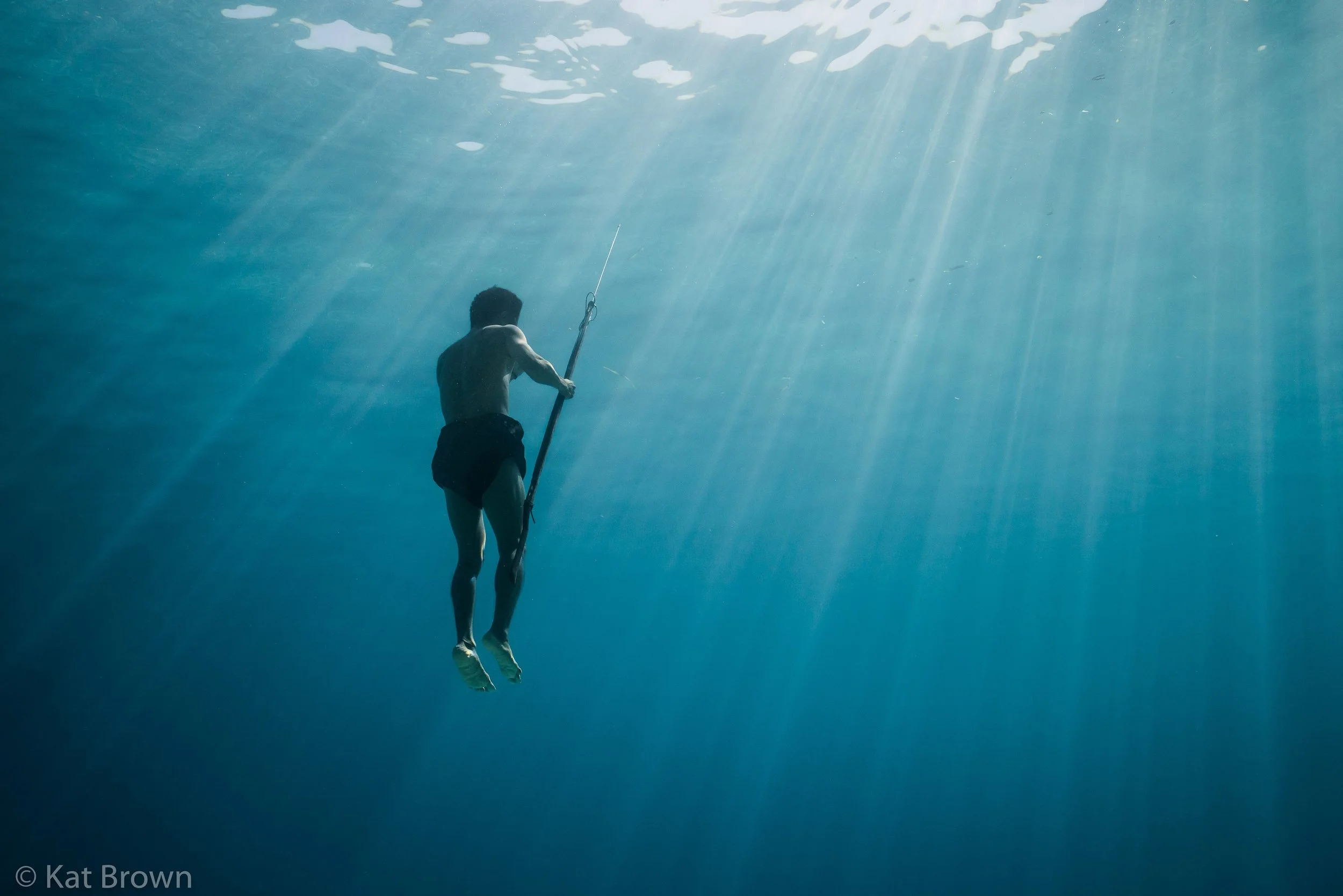


Mark returned to the Togean Islands, Sulawesi, Indonesia in autumn 2017 to film for the ‘Escape’ episode of National Geographic's 'One Strange Rock'
On location image credits © Kat Brown

Fujinon Lenses Q&A
What shoot have you recently taken the Fujinon lenses on?
“I’m just back from the Bahamas where I was working on a Shark Week shoot for Discovery. I was filming topside and drone from a boat for the duration, so camera and lens choice was key. My pair of E mount Fujinon lenses (MK18-55mm and MK50-135mm) were the natural choice together with my Sony FS7 as they are the perfect match especially for this type of job”
Tell us more about why the Fujinon lenses were a great fit for this shoot?
“The production wanted to achieve a cinematic look and feel using a shallow depth of field throughout. So, shooting wide open at T2.9 I was able to achieve some very pleasing results with the actuality. We filmed a large portion of the footage into the night (under the boats minimal lighting) so, in this environment with these lenses I was still able to expose the contributors effectively”
What USPs specific to the Fujinon lenses do you find most impressive?
“As well as ‘the look’ I wanted to achieve an additional consideration for the on-the-shoulder sync filming is the overall weight of the camera. So, with each lens weighing in at 0.9kg (which is incredibly light weight for such a lens) it makes for a much more comfortable set up; a hugely important factor when you’re working across the length and breadth of a boat for long hours, into the evening”
How did you utilise the full range of the two Fujinon lenses whilst on location?
“The 18-55 is great for general sync shots and actuality; wide enough to get establishes and two shots and tight enough for pushing in for close ups and details. When it comes to shooting with another member of the camera team the 50-135 is perfect for close up reactions”
'Animals with Cameras' BBC
In this three-part series, wildlife cameraman and presenter Gordon Buchanan collaborates with scientists in the field to attach cameras onto animals in the wild. On their journey, which takes them to all corners of the globe, they uncover unexpected findings about the lives of some of the planet's most captivating species. Mark filmed off the Princess Alice sea bank in the Azores during August 2017 for the Devil Ray sequence (featured in episode 3).
The team set out to discover why vast numbers of Devil Ray gather every summer near the Azores archipelago in the mid-Atlantic. The team successfully deployed specially designed cameras which towed behind the rays, these in turn witnessed wildlife spectacles seen for the first time including 'sun-bathing' ray at the surface reheating after a cold dive and unborn ray pups kicking inside their giant, four-meter-wide mothers; a sign that this congregation might be a breeding ground for these majestic ocean giants. Devil Rays are under threat from fishing, boat traffic, habitat decline and pollution and are currently listed as Endangered (EN) on the IUCN Red List. Although not usually targeted by fisheries, Devil Rays often become victims as bycatch. The good news is that Project AWARE have already made a positive impact to help protect Devil Rays.
“Devil Rays are fascinating creatures – they are some of the fastest and deepest divers in the ocean, and swim with such elegance. When they are not feeding, their cephalic fins are curled and point forward and down, giving the appearance of devil horns; hence their name.”


Other wildlife events captured within this series include penguins catching their prey 200 miles off the coast of Argentina and fur seals avoiding attacks from great white shark off Australia. Further details and clips are available here.
SCRUBD Master of the Month

As champions of men, SCRUBD are passionate about helping men to be masters in every area of their life. Every month we interview a true master, who is making a difference in the world around him.
Usually found behind the camera, this month the spotlight is on wildlife and underwater cameraman Mark Sharman who has worked on some of the most exciting wildlife documentaries of our time including the award-winning Jago a Life Underwater and Blue Planet II which has recently aired on BBC One.
How did you get involved in underwater filming and how did it feel filming underwater for the first time?
“I have been fascinated by scuba diving and the underwater world since I was a child. Scuba diving was a natural step for me as I was a competitive swimmer as a teenager and was always in and around the water growing up. I studied Television Production at university and after this I got my first jobs in the industry, as well as my first decent time diving on a conservation project. I put my two interests of camerawork and scuba diving together for a job in the Red Sea filming tourists and selling them a DVD of their week of diving. I felt a great sense of accomplishment getting to a place where I could put my two main interests together, and proud that I was on the way to achieving what I had set out to do.”
What are the most important skills needed to master underwater filming?
“Early on before I embarked on my career I was given the advice that you can’t create good underwater camerawork unless you have mastered neutral buoyancy, which is the most important part of being a scuba diver. The only way to do this is to get hundreds of dives under your belt in various conditions. The underwater filming process involves your scuba diving reflexes becoming automatic, so you can concentrate 100% on what you’re filming, without thinking about your position in the water. That, and manoeuvring around extremely delicate corals on the reef is an important part of the job, and the training and practice is endless.”
Natural History programmes have evolved with advances in technology – what new skills have you had to develop to maintain your craft?
“I’ve continually developed my craft and pushed new boundaries to keep up my skills as an all round cameraman, both on the land and underwater. Becoming a rebreather diver was a important step, as it is allows you to spend a lot more time underwater and get closer to certain marine life. That was like learning diving from scratch, and requires neutral buoyancy to be re-learned in a new way.
This year I’ve developed my drone flying skills to be able to fly and film aerial shots, and these skills need constant refinement and practice to be able to perform and deliver on demand right when the action is happening. There are not often second chances, so you have to be ready when the action starts, which takes a lot of dedication and time to achieve.”
‘Jago a Life Underwater’ is an award-winning film about the life story of an old Bajau man. What was it like to work with these underwater masters and film them in their element?
“Jago was an amazing production to work on; a low-budget, self-funded passion project by directors James Reed and James Morgan. It was the first time I’d met any Bajau people, or sea gypsies, and being able to tell a story from their point of view was special. They were incredible in the water, able to hold their breath for several minutes as they hunted with a spear-gun. Being able to work with people so adept in their environment was quite something, and really satisfying to be a part of such a small project which has received some of the biggest awards in the industry.”
Capturing the natural world on camera can be time consuming. How long would you spend filming in order to get all the footage required for a sequence?
“Shoots are generally between two and five weeks, three weeks is about average for a sequence you might see in a programme like Blue Planet II. Sometimes you get nothing for the first two weeks and everything happens on the last day….there have been a few of those. Developing patience and remaining upbeat and positive when the chips are down are key skills to master.”
What is your most memorable moment and have you had any scary encounters filming in the wild?
“Filming large marine life has been the most thrilling so far, it really reminds you of your size and place. I’ve filmed beside Whale Sharks, Sperm Whales, Humpback Whales and Orcas which were all incredibly memorable experiences. I’ve also had a brown Bear mother walk her two young cubs right past where I was sitting. In my experience all of these wild animals are generally quite shy and move away from you, so when the odd one allows you to stay close and film for a few minutes, they are really special moments. I don’t see the natural world as a scary place; wildlife is often misunderstood and sensationalised in the media, so I have a healthy respect for something which could do me harm. Ultimately you are in their domain so you have to move and act accordingly, and take advice from experts, and everyone is happy. The only time I’ve genuinely been threatened in the wild, is an encounter with poachers, whilst on patrol with eco guards in Gabon, filming the capture of a poacher and being shot at by the guys who ran away. I filmed the whole thing and it wasn’t until after the adrenaline wore off did I think of the danger we were in.”
What advice would you give to aspiring documentary makers?
“It’s going to be a long haul, so building resilience to set backs is key. There will always be double the amount of knock backs as there will be big breaks, so you’ve just got to keep going and keep finding different angles in. It’s a very competitive area to get into, so a deep and unshakable passion is needed. Getting any experience in the industry is a good move, taking every opportunity to learn and develop the craft with hands-on experience. Meet as many people as possible in the industry and keep in touch with them. Most of my work comes from recommendation, by reputation and from people I already know, so the bigger the network, the more chance there is of work coming in. People like working with nice people, so being easy and fun to work with is also something to consider.”
Quick Fire
How do you master your day?
“Going to the pool or gym in the morning, with a walk back home along the coast sets things up well. If there’s a lot of admin to do, getting fresh air, either with a walk, run or a drone flight by the sea is good for clearing the head. Getting through my list of things to do keeps everything ticking over and on track.”
If you could have dinner with three male masters, who would they be and why?
“David Attenborough, Ernest Hemingway, Alfred Hitchcock. Three men’s work I’ve greatly enjoyed and admired. All story-tellers by trade, it would be a masterclass.”
The best piece of advice you have ever received?
“Stay focussed and keep going.”